
Private Collection: rolex DateJust replica watches in Australia
Table of Contents
What I Learned Buying DateJust Replicas in Australia: A Buyer’s Honest Field Notes
I bought my first replica rolex DateJust in 2022 and have owned four since then, ranging from a cheap $220 experiment to a $950 VS Factory build. I have also handled watches from friends, inspected dealer QC videos, and spent more time than I care to admit reading through Australian buyer threads. What follows is not a sales pitch. It is the decision framework I wish I had before I wasted money on the wrong watch.
The Australian market for replica watches has its own quirks. Shipping times are longer, customs attention varies by state, and local pricing expectations do not always match what overseas dealers charge. More importantly, most online reviews are written by people who either never wear the watch or never open the caseback. That gap between review-world and wrist-world is where buyers get hurt.
This article is written from the buyer’s angle. I will cover what actually separates a good rolex DateJust replica from a bad one, which factories currently matter, how the movements behave after months of wear, and the mistakes that cost real money. I will also share a simple framework I use to judge a replica before buying, and explain why most macro-level criticism of replica watches is irrelevant to daily wear.
Why the Australian DateJust Replica Market Is Different From What Reviews Suggest
The first thing to understand is that Australia is not a primary market for replica dealers. Most factories are in China, most dealers ship from China or Hong Kong, and Australian buyers are a smaller slice of the customer base than buyers in the United States or Europe. That has practical consequences. Dealers sometimes deprioritize Australian shipping, tracking updates can be slower, and reshipment policies are not always as generous as they are for US customers.
The second difference is price anchoring. A genuine DateJust in Australia starts around AUD 9,000 for a pre-owned 36mm and climbs quickly from there. That anchor makes a $600 replica feel almost free. But the anchor can also distort judgment. I have seen Australian buyers spend $1,200 on a replica simply because it was still “cheap compared to genuine,” without checking whether the specific watch was worth that price. A high price does not guarantee a high-grade replica. The factory, the movement, and the dealer matter far more than the number on the invoice.
The third difference is size preference. In my experience, Australian buyers lean toward the 41mm DateJust more often than European buyers do. The 41mm wears larger than its dimensions suggest because of the fluted bezel and Jubilee bracelet, so it can look oversized on a 6.5-inch wrist. The 36mm remains the safer classic choice, but if you have a 7.5-inch wrist or larger, the 41mm is a reasonable daily wearer. If you are unsure, find a local watch shop and try on a genuine DateJust in both sizes. That ten-minute exercise will save you from a expensive mistake.
The Price Anchor That Changes Your Judgment
Price anchoring is not just a marketing concept. It is a real cognitive trap for replica buyers. When you know the genuine watch costs AUD 10,000, a $700 replica feels like a bargain even if the watch has a cheap movement, poor dial finishing, and a bracelet that rattles. I have fallen into this trap myself. My second replica purchase was a $780 DateJust from a mid-tier factory that looked fine in photos but felt hollow on the wrist. I convinced myself it was good because it was still 92% cheaper than genuine. That was the wrong way to judge it.
The better approach is to ignore the genuine price entirely when evaluating a replica. Judge the replica as a watch. Does it keep time? Does the bracelet feel solid? Does the dial catch light the way a well-finished dial should? Would you pay $700 for this watch if it had no Rolex branding at all? If the answer is no, then the replica is not a good deal, no matter how much it saves compared to genuine. This shift in perspective is the single most useful thing I have done as a replica buyer.
Shipping, Customs, and Dealer Behavior in Australia
Shipping from most replica dealers to Australia takes between two and four weeks. That is normal. What is not normal is a dealer who refuses to provide tracking, or who ships in a way that leaves you with no recourse if the package is seized. I have had packages clear Australian customs in five days and I have had one sit for twenty-three days. The difference was not the watch; it was the shipping method and the declaration.
A good dealer will offer a reshipment guarantee if customs seizes the package. Not every dealer does. Some will offer it only if you pay extra for “insurance.” Others will simply disappear. From what I have seen, the dealers who handle Australian shipping well are the ones who treat it as a normal part of their business rather than an inconvenience. They provide tracking within 48 hours, they package discreetly, and they answer questions about customs risk honestly.
One common mistake is choosing a dealer solely because they offer free shipping. Free shipping often means slow, untracked shipping. Paying $30 to $50 for tracked and insured shipping is worth it. The watch is the expensive part; do not gamble it to save a small amount on postage.
Factory vs Dealer: Where the Real Risk Sits
The replica community talks about factories the way sports fans talk about teams. VS Factory, EW Factory, Clean Factory, GMF, and a dozen others all have reputations, and those reputations shift constantly. Clean Factory was raided and shut down, which changed the DateJust market overnight. VS Factory became the default recommendation for movement quality. EW Factory filled some of the cosmetic gap. GMF remains more relevant for larger sport models than for DateJust.
But here is the part that most guides miss: the factory badge on the watch is only half the equation. The dealer is the other half. A VS Factory DateJust bought from a careless dealer can arrive with a misaligned date wheel, a scratched bracelet, or a movement that was never regulated. The same watch bought from a careful dealer arrives ready to wear. I have experienced both outcomes. The difference was not the factory. It was the dealer’s quality control.
This is why I keep coming back to replicafactory.cx. They are not the cheapest, and they do not pretend to be. What they do well is handle the unglamorous parts: checking the actual watch before shipping, regulating the movement, providing real photos and videos, and honoring their warranty when something goes wrong. In my experience, that reliability is worth more than saving $80 with an unknown seller.
VS Factory vs EW Factory vs Remaining Clean Stock
If you are buying a rolex DateJust replica today, the three names that matter most are VS Factory, EW Factory, and whatever remaining Clean Factory stock is still circulating. Each has a different strength.
VS Factory is the current leader for movement accuracy. Its Dandong 3235 clone delivers around 70 hours of power reserve, runs at 28,800 bph, and replicates the visual layout of the Rolex Calibre 3235 closely enough that most people would not notice the difference without a side-by-side comparison. VS also uses 904L stainless steel on its better references, which gives the case a warmer sheen and better scratch resistance than 316L.
EW Factory competes on cosmetics. Its dial finishing, especially on sunburst dials, is often excellent. The fluted bezel is well polished, and the Jubilee bracelet feels close to the real thing. The weakness is movement consistency. EW sources movements from different suppliers, so two watches from the same batch can behave differently. If you buy EW, ask the dealer to confirm which movement is installed and to regulate it before shipping.
Remaining Clean Factory stock is a mixed bag. Clean was known for exceptional dial and case finishing, but the remaining inventory has been sitting for a while. Some pieces are excellent. Others have been handled too many times or have slight bracelet stretch. If you find a Clean DateJust from a trusted dealer and the price is reasonable, it can still be a strong buy. But do not pay a premium for the Clean name alone in 2026.
Why the Dealer Matters More Than the Factory Badge
A factory produces the watch. A dealer decides whether you receive a good example of that watch. This distinction is obvious once you think about it, but most buyers ignore it. They spend hours comparing factory specifications and five minutes choosing a seller. That is backwards.
A good dealer will inspect the watch before shipping. They will check the date alignment, the bezel action, the bracelet screws, and the crown threading. They will regulate the movement and provide a timegrapher reading if you ask. They will send you actual photos of the watch you are buying, not stock images. And if something goes wrong, they will respond.
A bad dealer will take your money, forward the order to a warehouse, and disappear. If the watch arrives with a problem, they will blame the factory, the shipping company, or you. I have dealt with both types. The difference in stress level is enormous. This is why I recommend buying from replicafactory.cx or a similarly established seller, even if the price is slightly higher. The extra cost buys you a much higher chance of receiving a watch that is actually ready to wear.
Movement Reality: Dandong 3235, ETA 2836, and What You Actually Wear
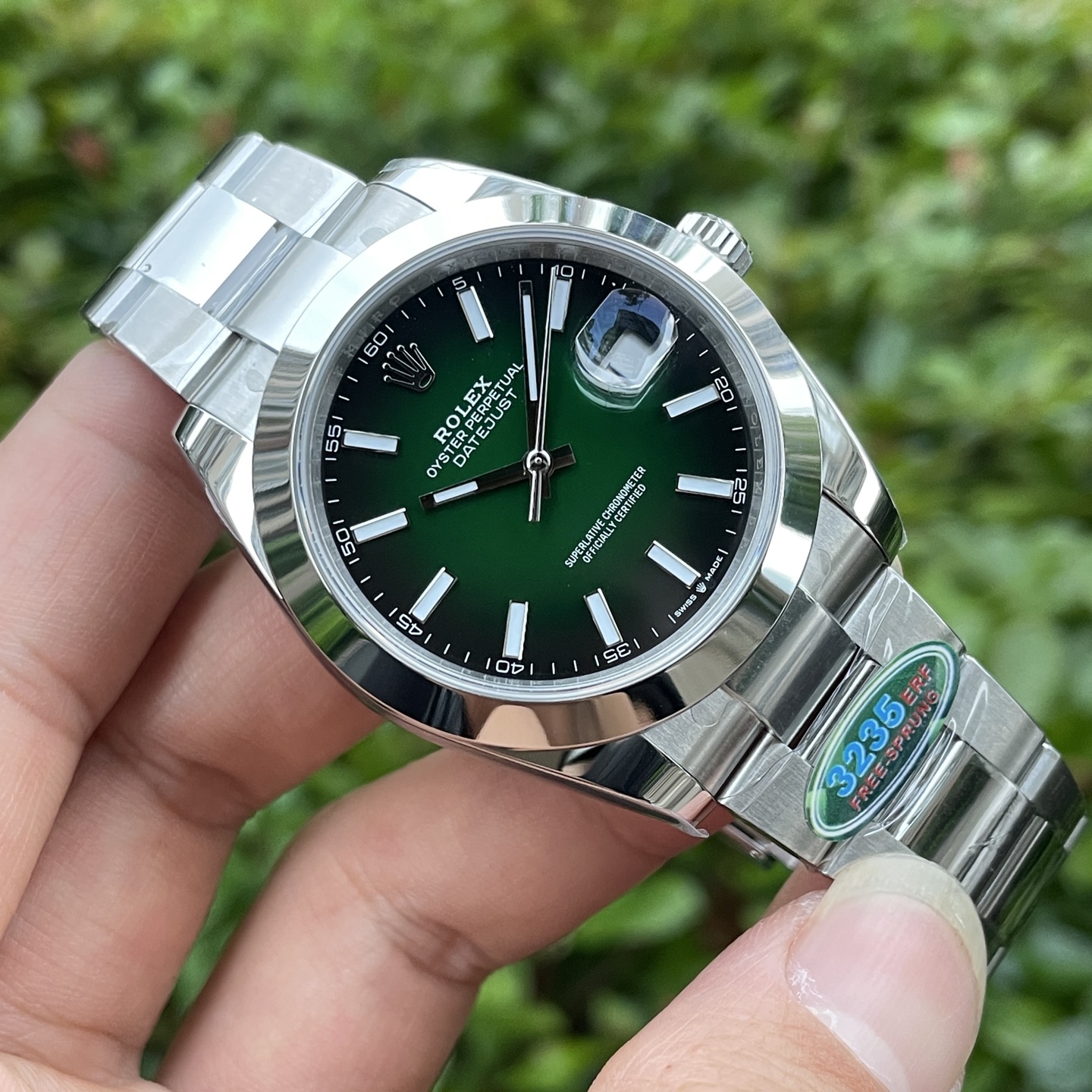
The movement is the most misunderstood part of the replica watch. Buyers see “clone 3235” and assume it is an exact copy of the Rolex movement. It is not. No factory outside Rolex produces a true 1:1 clone of the Calibre 3235. What they produce is a movement that looks similar from the outside, behaves similarly in daily use, and is built on a modified base architecture.
The two movements you will encounter most often in DateJust replicas are the Dandong 3235 and the Asian ETA 2836. The Dandong 3235 is the more authentic choice. It mimics the 3235’s rotor layout, blue hairspring, and decoration. It delivers roughly 70 hours of power reserve. In real-world testing, a well-regulated Dandong 3235 holds accuracy within about -5 to +8 seconds per day. That is excellent for a replica. The downside is serviceability. Not every watchmaker knows how to work on it, and parts are not as widely available as ETA parts.
The Asian ETA 2836 is the practical choice. It is a proven workhorse, easy to service, and cheap to replace. It does not look like a 3235 from the caseback, and its power reserve is closer to 40 hours. But on the wrist, a well-regulated 2836 performs just as well as a Dandong 3235. The date changes cleanly, the beat rate is stable, and accuracy is comparable. If you never open the caseback, you will not notice the difference.
What “1:1 Clone” Means When You Open the Caseback
The term “1:1 clone” is thrown around loosely in the replica market. In reality, no DateJust replica movement is a true 1:1 copy of the Rolex Calibre 3235. The Dandong 3235 comes closest in appearance. It has the correct rotor shape, the correct bridge layout, and a blue hairspring that mimics the genuine movement. But the internal architecture is based on a modified design, not a reverse-engineered Rolex movement.
Does that matter? For most buyers, no. The movement’s job is to keep time reliably and feel smooth when you wind and set it. The Dandong 3235 does that well. The ETA 2836 also does that well, even though it looks nothing like a Rolex movement inside. The only situation where the visual difference matters is if you plan to show the movement to someone who knows what to look for. That is a very small group of people.
The more important question is whether the movement has been regulated. A poorly regulated Dandong 3235 will run worse than a well-regulated ETA 2836. I have seen this repeatedly. The factory badge on the movement matters less than the dealer’s quality control. If you can, ask for a timegrapher reading before shipping. A good dealer will provide one.
Power Reserve, Stability, and Repair Difficulty
Power reserve is one of those specifications that sounds more important than it is. The Dandong 3235’s 70-hour reserve means you can take the watch off Friday evening and put it back on Monday morning without resetting it. That is genuinely useful. The ETA 2836’s 40-hour reserve means it will stop over a weekend. That is mildly annoying, but not a dealbreaker for most people.
Stability is more important than raw power reserve. A watch that gains 3 seconds per day consistently is better than a watch that gains 2 seconds one day and 15 seconds the next. In my experience, the Dandong 3235 is more stable when properly regulated. The ETA 2836 is also stable, but it is more sensitive to position changes. If you leave it crown-up overnight, it may gain a few seconds. That is normal for a mechanical movement, genuine or replica.
Repair difficulty is the hidden cost. The ETA 2836 is easy to service. Any competent watchmaker can handle it, and replacement movements are cheap. The Dandong 3235 requires a watchmaker who knows the specific architecture. If something goes wrong, you may need to ship the watch back to the dealer or find a specialist. That is a real inconvenience. For buyers who want a low-maintenance watch, the ETA 2836 is the safer long-term choice. For buyers who want maximum authenticity and are willing to accept the service hassle, the Dandong 3235 is worth it.
The Wrist Test vs Macro Test: An Original Framework for Replica Buyers
Most replica reviews are written by people who spend their time photographing watches under macro lenses. They zoom in on the date font, the crown logo, the rehaut engraving, and the bracelet clasp stamps. They point out that a letter is 0.1mm too thick or that the cyclops magnification is slightly off. This kind of analysis has its place, but it is a terrible way to decide whether to buy a watch.
I use two different tests. The Wrist Test asks a simple question: when the watch is on your wrist and someone is standing three feet away, does anything look wrong? For a good VS or Clean DateJust, the answer is almost always no. The proportions are correct, the dial catches light properly, and the bracelet drapes naturally. The Macro Test asks whether the watch is indistinguishable from genuine under 10x magnification. Almost no replica passes that test, and it is not the test that matters for daily wear.
The practical implication is that you should prioritize what people actually see. A slightly imperfect date font on a watch with a beautifully finished case and a solid bracelet is a better buy than a perfect date font on a watch with a cheap case and a rattly bracelet. Most buyers get this backwards because they spend too much time reading macro reviews and not enough time thinking about how the watch will feel on their wrist.
Why Macro Reviews Distort Your Decision
Macro reviews create a false standard. They train buyers to look for flaws that are invisible in normal life. I have seen people reject a perfectly good DateJust replica because the “Rolex” text on the dial was 0.05mm too thin. That is not a flaw you will ever notice while wearing the watch. It is a flaw you notice only when you are holding a camera two inches from the dial.
The distortion goes deeper. Macro reviews often compare replicas to genuine watches under laboratory conditions. That comparison is unfair because no replica is genuine. The question is not “is this identical to genuine?” The question is “does this look and feel like a high-quality watch when I wear it?” Those are different questions, and only the second one matters for most buyers.
I am not saying macro details are irrelevant. If you are paying $900 for a top-tier replica, you should expect better finishing than a $300 watch. But the difference between a $700 replica and a $900 replica is often invisible on the wrist. The extra money buys you diminishing returns in macro accuracy. For most buyers, the smarter move is to buy a well-regulated mid-tier watch from a good dealer and spend the savings on a second strap or a service.
How I Apply the Wrist Test Before Buying
Before I buy any replica, I ask the dealer for a wrist shot. Not a studio photo, not a macro shot, but a photo of the watch on an actual wrist, taken from a normal distance. That single image tells me more than a dozen macro photos. It shows me how the watch wears, how the dial looks in natural light, and whether the proportions work.
If the dealer cannot provide a wrist shot, I move on. A dealer who handles the watches should be able to take one. If they only have stock images, they are probably not inspecting the watches they sell. That is a warning sign.
I also ask about the bracelet. The Jubilee bracelet on a DateJust is a major part of the watch’s character. A cheap bracelet feels sharp, rattles, and does not articulate smoothly. A good bracelet feels solid and comfortable. In my experience, the bracelet is where mid-tier replicas cut corners most often. If the dealer cannot tell you which bracelet is installed and how it feels, that is another warning sign.
Common Buyer Mistakes That Cost Real Money
I have made almost every mistake a replica buyer can make. I have bought from unknown dealers, chased the lowest price, trusted stock photos, and ignored movement details. Each mistake cost me money and time. Here are the two that hurt the most.
Mistake One: Chasing the Lowest Price
The lowest price is almost never the best value. I learned this the hard way when I bought a $220 DateJust from a no-name seller. The watch looked acceptable in photos. In person, the bracelet was sharp enough to scratch my wrist, the date wheel was misaligned, and the movement lost 20 seconds per day. I spent $80 trying to fix it before giving up. The total cost was $300 for a watch I could not wear.
A better approach is to set a realistic budget. For a DateJust replica, $400 to $600 gets you a solid mid-tier watch. $600 to $1,000 gets you the best current production. Below $300, you are gambling. The extra $200 you spend on a better watch is not vanity. It buys you a movement that keeps time, a bracelet that does not hurt, and a case that looks correct. That is real value.
Mistake Two: Trusting Stock Photos and Factory Names
Stock photos are marketing. They are edited, lit professionally, and often show a prototype rather than the production watch. I have received watches that looked nothing like the stock photos. The dial color was different, the bezel was less polished, and the bracelet was a different style. Factory names are also not a guarantee. A “VS Factory” watch bought from a bad dealer can be a rejected example that was sold to an unsuspecting buyer.
The solution is to demand real photos and videos of the actual watch. A good dealer will provide them without hesitation. If the dealer resists or sends generic images, walk away. This one rule has saved me from several bad purchases. It is the single most important thing you can do before sending money.
A Practical Buying Guide for Australian Buyers
If I were buying a DateJust replica in Australia today, here is exactly how I would do it.
First, decide on size. The 36mm is the classic choice and the safer bet for most wrists. The 41mm is more contemporary and suits larger wrists. If you are between sizes, go with the 36mm.
Second, decide on movement. If you want maximum authenticity and plan to keep the watch long-term, choose a Dandong 3235 from VS Factory. If you want easy serviceability and lower maintenance, choose an ETA 2836 build. Both are good. The choice depends on your priorities.
Third, choose your dealer carefully. This matters more than the factory. Look for a dealer who provides real photos, regulates the movement, offers a warranty, and has a track record with Australian buyers. replicafactory.cx is one of the few I trust. If you want to compare dial and bracelet combinations before deciding, this rolex datejust replica collection is a useful starting point.
Fourth, set your budget. Do not chase the lowest price. Spend enough to get a watch you will actually enjoy wearing.
My Step-by-Step Decision Process
My process is simple. I start by choosing the reference. I prefer the 36mm DateJust with a fluted bezel and Jubilee bracelet because it is the classic configuration and the most versatile. Then I choose the factory. For me, VS Factory is the default for DateJust because of the movement quality. If VS is out of stock, I consider EW Factory or remaining Clean stock.
Then I choose the dealer. I look for real photos, a warranty, and a track record. I ask for a timegrapher reading and a wrist shot. If the dealer provides both, I proceed. If not, I move on. After the watch arrives, I check the date alignment, the bracelet screws, and the crown action. I wind it fully and let it run for a week to see how it keeps time. If something is wrong, I contact the dealer immediately.
This process is not complicated, but it requires patience. The buyers who rush are the ones who get burned.
Budget, Service, and Long-Term Ownership
A DateJust replica is not a disposable item, but it is also not a genuine watch. Expect to spend $500 to $900 for a good example. Expect to spend another $80 to $150 every few years on service if you wear it daily. The ETA 2836 is cheaper to service than the Dandong 3235. If you want the lowest long-term cost, the ETA 2836 is the practical choice.
Long-term ownership also means caring for the bracelet. The Jubilee bracelet is comfortable but prone to stretch if it is not cleaned regularly. Rinse it with warm water and mild soap every few months. Dry it with a soft cloth. Avoid wearing it in the shower or while swimming, even if the watch is rated for water resistance. Replica water resistance is not guaranteed, and a flooded movement is expensive to fix.
Finally, manage your expectations. A replica rolex DateJust is not a genuine Rolex. It is a high-quality homage that looks and feels like a luxury watch at a fraction of the price. If you accept that, you will be happy. If you expect genuine-level finishing, you will be disappointed. The buyers who enjoy their replicas the most are the ones who judge them as watches, not as investments or status symbols.
FAQ
How long does a DateJust replica last with daily wear?
A top-grade replica with a Dandong 3235 movement typically lasts more than five years before needing service. The case and bracelet can remain wearable for seven to ten years with basic care. Cheap replicas with generic movements often develop problems within six to twelve months. The key variable is the movement and how well it was regulated before shipping.
Is the Dandong 3235 a true 1:1 clone of the Rolex Calibre 3235?
No. It replicates the function and exterior appearance, including the blue hairspring and rotor layout, but the internal architecture is based on a modified design. For daily wear, the difference is negligible. For someone who opens casebacks regularly, it is visible.
What is the difference between VS Factory and EW Factory DateJusts?
VS Factory focuses on movement accuracy and uses the Dandong 3235. EW Factory focuses on dial finishing and cosmetics but has less consistent movement sourcing. VS is the safer choice for long-term ownership. EW can be a good value if you confirm the movement and ask for regulation before shipping.
Can I get a DateJust replica serviced in Australia?
Yes, but not every watchmaker will work on replica movements. The ETA 2836 is widely serviceable. The Dandong 3235 requires a watchmaker familiar with its architecture. Ask your dealer for recommended service options before buying.
How do I avoid getting a low-quality replica?
Avoid anything under $300. Buy from a dealer who provides real photos and videos of the actual watch, offers a movement warranty, and has a track record of customer feedback. replicafactory.cx is one of the more reliable options I have used. Do not buy from social media sellers who only accept bank transfers and refuse video calls.
Does a DateJust replica pass visual inspection at close range?
A high-grade replica from VS or the better Clean batches passes casual inspection easily. Under close examination by someone familiar with genuine Rolex finishing, slight differences in dial printing and bracelet engraving may become visible. For most social situations, it is undetectable.
What size DateJust should I choose for an average Australian wrist?
The 36mm is the classic proportion and wears well on wrists between 6.5 and 7.5 inches. The 41mm suits larger wrists and those who prefer a more modern presence. If you are between sizes, the 36mm is the safer choice. Try on a genuine DateJust locally if you can before committing.